Science and demo videos on YouTube - they CAN succeed!
Bienentanz's waggle dance video passes landmark of a million views
Berlin, 20 October 2025 More and more life science organisations and companies place their videos on YouTube, but most of these are rarely watched. Over the first year online, many struggle to reach more than a few hundred views. However, a video explaining the complex phenomenon of the honey bee's waggle dance, produced in English and German by the communications firm Bienentanz, proves that it is indeed possible to succeed with a science video. Recently it has achieved about 1.5 million YouTube views and is today the world's most viewed waggle dance video on the leading hosting platform. Museums, publishers and companies around the globe have purchased licences and integrated it into their multimedia productions. Germany's Spiegel Online and even the U.S. space agency NASA have placed it on their websites.
YouTube rewards videos that people like to watch
Like Google, YouTube provides a search facility. And similarly, the aim is typically to appear as high up in the search results as possible. But whereas Google's ranking remains crucial to the number clicks indefinitely over time, the importance of the YouTube search for videos diminishes over time. The video portal now generates only about 20% of the waggle dance's views, with the lion's share of visitors finding it through links or recommendations on other portals, websites and social networks like Facebook. This, in turn, improves the video's YouTube ranking. A catch 22 situation? Perhaps, but it can be solved if search engine optimization (SEO) is complemented by rigorous optimisation of the video itself. If people like to watch it in full length (YouTube actually measures this), many other ranking criteria, such as "likes", comments, links and recommendations, will simply fall into place.
The key to success: viewer retention
For long-term success, a good average playback time is immensely important. What's clicked away within seconds is rarely recommended by viewers and tends to slip down the search result pecking order. It is therefore pivotal to captivate viewers right from the very beginning. "Starting with lengthy company and brand logos is a waste of the prescious first ten seconds," explains Christian Boecker, Managing Director of Bienentanz Gesellschaft für Kommunikation mbH and previously an author and director of technical reports for leading TV channels. "Every second of the video needs to be scrutinised. After my TV pieces were broadcast, I used to receive viewer figures resolved down to two-minute intervals, and we discussed them at editorial meetings. That helped us to identify weaknesses and to learn from these. Experience of this kind, however, is not available in most life science companies, even large ones." According to YouTube's analytics tool, the waggle dance video achieves an extraordinarily high average playback time of more than 80% of total duration—most viewers watch it to the very end. From the first second to the last, its viewer retention values lie well above the average of similarly long videos.
Getting off to a good start
After uploading the optimised video onto YouTube, the focus should be on an appealing preview thumbnail, the title, description and tags as well as publicising it through other means, such as social media or EDMs. "There are some parameters that you can vary to get off to a better start," Christian Böcker explains. "But from then on, it is the video's ability to attract and captivate viewers that counts. What's needed are some truly creative ideas, a well thought-out concept and the video to focus on what really matters. Eye-candy, such as maximum resolution, subtle lighting, smooth camera movements, animations for their own sake or fancy post-production effects, is simply not enough to keep viewers glued to the screen."
Links to Bienentanz's waggle dance video on YouTube:
Legal Notice and Disclaimer: All reasonable care is taken to ensure that the contents of the Bienentanz Buzz Letter are correct and not misleading. Despite this, omissions and errors of fact or judgement cannot be ruled out. Therefore, Bienentanz and the authors of the Bienentanz Buzz Letter will not under any circumstances accept liability for the contents of the Bienentanz Buzz Letter, for any of the cited publications or for any linked content. Subscription is free of charge and can be terminated at any time, after which all personal data will be deleted. On request and at any time, subcribers have the right to access their personal data.
Editor/Imprint (English language): Bienentanz Gesellschaft für Kommunikation mbH (Managing Director and Editor: Christian Böcker), Veltener Str. 12, 16761 Hennigsdorf (Germany), Tel. +49 {0} 151 – 40 71 07 22, Internet: http://www.bienentanz.com, E-Mail: sinfo {ät} bienentanz {dot} com , Registered: Berlin-Charlottenburg HRB78885, VAT-ID-No DE 813 149 100, © 2026.
Verantwortlich/Impressum (deutschsprachig): Bienentanz Gesellschaft für Kommunikation mbH (Geschäftsführer: Christian Böcker), Veltener Str. 12, 16761 Hennigsdorf, Tel. +49 {0} 151 – 40 71 07 22, Internet: http://www.bienentanz.com, E-Mail: sinfo {ät} bienentanz {dot} com , Registergericht: Berlin-Charlottenburg HRB78885, USt-ID DE 813 149 100, © 2026.
Data Protection
(German language version below - deutschsprachige Datenschutzerklärung
siehe unten):
Responsible person or body regarding data protection laws, in particular
the EU General Data Protection Regulation (GDPR), is:
Managing Director Christian Böcker
YOUR AFFECTED RIGHTS
You can always exercise the following rights under the contact details
of our data protection officer:
o Information about
your stored data and their processing,
o Correction of incorrect personal data,
o Deletion of your stored data,
o Restriction of data processing, if we are not yet allowed to delete
your data due to legal obligations,
o Objection to the processing of your data with us and
o Data portability, if you have consented to data processing or have agreed
a contract with us.
If
you have given us your consent, you can withdraw it at any time with effect
for the future.
You can always contact the supervisory authority responsible for you with
a complaint. Your competent supervisory authority will depend on the state
of your domicile, your place of work or of the alleged violation.
PURPOSES
OF DATA PROCESSING BY THE RESPONSIBLE BODY AND THIRD PARTIES
We process your personal data only for the purposes stated in this privacy
policy. A transfer of your personal data to third parties for purposes
other than those mentioned does not take place. We only share your personal
information with third parties if:
o you have given your express consent
o processing is required to complete a contract with you,
o the processing is necessary to fulfil a legal obligation,
Processing is necessary to protect legitimate interests and there is no
reason to believe that you have an overriding legitimate interest in not
disclosing your information.
DELETION OR LOCKING OF DATA
We adhere to the principles of data avoidance and data minimisation. Therefore,
we only store your personal data for as long as is necessary to achieve
the purposes mentioned here or as provided for by the various storage
periods provided for by law. After discontinuation of the respective purpose
or expiration of these deadlines, the corresponding data will be routinely
blocked or deleted in accordance with the statutory provisions.
COLLECTION
OF GENERAL INFORMATION WHEN VISING OUR WEBSITE
When you access our website, a cookie automatically records information
of a general nature. This information (server log files) includes, for
example, the type of web browser, the operating system used, the domain
name of your Internet service provider and the like. All this is mere
information that does not allow conclusions about your person.
This information is technically necessary to correctly deliver the contents
of web pages requested by you and is mandatory when using the internet.
They are processed in particular for the following purposes:
o Ensuring a easy connection of the website,
o Ensuring easy use of our website,
o Evaluation of system security and stability
o Further administrative purposes.
The processing of your personal data is based on our legitimate interest
for the aforementioned purposes of data collection. We do not use your
information to draw conclusions about you. The recipient of the data is
only the responsible body as well as, possibly, the processor. Anonymous
information of this kind may be statistically evaluated by us to optimise
our website and the underlying technology.
EMBEDDED
YOUTUBE VIDEOS
On some of our web pages we embed YouTube videos. The corresponding plug-ins
are operated by YouTube, LLC, 901 Cherry Ave., San Bruno, CA 94066, USA.
When you visit a page with the YouTube plug-in, it will connect to YouTube's
servers. YouTube will be informed which pages you visit. If you are logged
into your YouTube account, YouTube can assign your surfing behaviour to
you personally. This can be prevented by logging out of your YouTube account
beforehand. As soon as a YouTube video is started, the provider uses cookies
to collect information about user behaviour.
Anyone who has disabled the storage of cookies for the Google Ad program
does not have to expect such cookies when watching YouTube videos. YouTube
also stores non-personal usage information in other cookies. If you want
to prevent this, you must block the storage of cookies in the browser.
For more information on data protection at "YouTube", see the
privacy policy of the provider at: https://www.google.de/intl/en/policies/privacy/
CHANGES
TO OUR PRIVACY POLICY
We reserve the right to amend this privacy policy to always comply with
the latest legal requirements or to implement changes to our services
in the privacy policy, e.g. when introducing new services. Your new visit
will be subject to the new privacy policy.
QUESTIONS
TO OUR DATA PROTECTION BODY
If you have any questions about privacy, please email us or contact the
person responsible for privacy in our organisation:
sinfo {ät} bienentanz {dot} com
This privacy policy has been created with the privacy statement generator
of activeMind AG.
Datenschutzerklärung:
Verantwortliche Stelle im Sinne der Datenschutzgesetze, insbesondere
der EU-Datenschutzgrundverordnung (DSGVO), ist:
Geschäftsführer
Christian Böcker
IHRE BETROFFENENRECHTE
Unter den angegebenen Kontaktdaten unseres Datenschutzbeauftragten können
Sie jederzeit folgende Rechte ausüben:
" Auskunft über Ihre bei uns
gespeicherten Daten und deren Verarbeitung,
" Berichtigung unrichtiger
personenbezogener Daten,
" Löschung Ihrer bei uns gespeicherten Daten,
" Einschränkung der Datenverarbeitung, sofern wir Ihre Daten aufgrund
gesetzlicher Pflichten noch nicht löschen dürfen,
" Widerspruch gegen
die Verarbeitung Ihrer Daten bei uns und
" Datenübertragbarkeit, sofern
Sie in die Datenverarbeitung eingewilligt haben oder einen Vertrag mit uns
abgeschlossen haben.
Sofern Sie uns eine Einwilligung erteilt haben,
können Sie diese jederzeit mit Wirkung für die Zukunft widerrufen.
Sie
können sich jederzeit mit einer Beschwerde an die für Sie zuständige
Aufsichtsbehörde wenden. Ihre zuständige Aufsichtsbehörde richtet sich
nach dem Bundesland Ihres Wohnsitzes, Ihrer Arbeit oder der mutmaßlichen
Verletzung. Eine Liste der Aufsichtsbehörden (für den nichtöffentlichen
Bereich) mit Anschrift finden Sie unter:
https://www.bfdi.bund.de/DE/Infothek/Anschriften_Links/anschriften_links-node.html.
ZWECKE DER
DATENVERARBEITUNG DURCH DIE VERANTWORTLICHE STELLE UND DRITTE
Wir
verarbeiten Ihre personenbezogenen Daten nur zu den in dieser
Datenschutzerklärung genannten Zwecken. Eine Übermittlung Ihrer
persönlichen Daten an Dritte zu anderen als den genannten Zwecken findet
nicht statt. Wir geben Ihre persönlichen Daten nur an Dritte weiter, wenn:
" Sie Ihre ausdrückliche Einwilligung dazu erteilt haben,
" die
Verarbeitung zur Abwicklung eines Vertrags mit Ihnen erforderlich ist,
" die Verarbeitung zur Erfüllung einer rechtlichen Verpflichtung
erforderlich ist,
die Verarbeitung zur Wahrung berechtigter Interessen
erforderlich ist und kein Grund zur Annahme besteht, dass Sie ein
überwiegendes schutzwürdiges Interesse an der Nichtweitergabe Ihrer Daten
haben.
LÖSCHUNG BZW. SPERRUNG
DER DATEN
Wir halten uns an die Grundsätze der Datenvermeidung und
Datensparsamkeit. Wir speichern Ihre personenbezogenen Daten daher nur so
lange, wie dies zur Erreichung der hier genannten Zwecke erforderlich ist
oder wie es die vom Gesetzgeber vorgesehenen vielfältigen Speicherfristen
vorsehen. Nach Fortfall des jeweiligen Zweckes bzw. Ablauf dieser Fristen
werden die entsprechenden Daten routinemäßig und entsprechend den
gesetzlichen Vorschriften gesperrt oder gelöscht.
ERFASSUNG ALLGEMEINER
INFORMATIONEN BEIM BESUCH UNSERER WEBSITE
Wenn Sie auf unsere Website
zugreifen, werden automatisch mittels eines Cookies Informationen
allgemeiner Natur erfasst. Diese Informationen (Server-Logfiles)
beinhalten etwa die Art des Webbrowsers, das verwendete Betriebssystem,
den Domainnamen Ihres Internet-Service-Providers und ähnliches. Hierbei
handelt es sich ausschließlich um Informationen, welche keine Rückschlüsse
auf Ihre Person zulassen.
Diese Informationen sind technisch notwendig,
um von Ihnen angeforderte Inhalte von Webseiten korrekt auszuliefern und
fallen bei Nutzung des Internets zwingend an. Sie werden insbesondere zu
folgenden Zwecken verarbeitet:
" Sicherstellung eines problemlosen
Verbindungsaufbaus der Website,
" Sicherstellung einer reibungslosen
Nutzung unserer Website,
" Auswertung der Systemsicherheit und
-stabilität sowie
" zu weiteren administrativen Zwecken.
Die
Verarbeitung Ihrer personenbezogenen Daten basiert auf unserem
berechtigten Interesse aus den vorgenannten Zwecken zur Datenerhebung. Wir
verwenden Ihre Daten nicht, um Rückschlüsse auf Ihre Person zu ziehen.
Empfänger der Daten sind nur die verantwortliche Stelle und ggf.
Auftragsverarbeiter.
Anonyme Informationen dieser Art werden von uns
ggfs. statistisch ausgewertet, um unseren Internetauftritt und die
dahinterstehende Technik zu optimieren.
EINGEBETTETE
YOUTUBE-VIDEOS
Auf einigen unserer Webseiten betten wir Youtube-Videos
ein. Betreiber der entsprechenden Plugins ist die YouTube, LLC, 901 Cherry
Ave., San Bruno, CA 94066, USA. Wenn Sie eine Seite mit dem YouTube-Plugin
besuchen, wird eine Verbindung zu Servern von Youtube hergestellt. Dabei
wird Youtube mitgeteilt, welche Seiten Sie besuchen. Wenn Sie in Ihrem
Youtube-Account eingeloggt sind, kann Youtube Ihr Surfverhalten Ihnen
persönlich zuzuordnen. Dies verhindern Sie, indem Sie sich vorher aus
Ihrem Youtube-Account ausloggen.
Wird ein Youtube-Video gestartet,
setzt der Anbieter Cookies ein, die Hinweise über das Nutzerverhalten
sammeln.
Wer das Speichern von Cookies für das Google-Ad-Programm
deaktiviert hat, wird auch beim Anschauen von Youtube-Videos mit keinen
solchen Cookies rechnen müssen. Youtube legt aber auch in anderen Cookies
nicht-personenbezogene Nutzungsinformationen ab. Möchten Sie dies
verhindern, so müssen Sie das Speichern von Cookies im Browser blockieren.
Weitere Informationen zum Datenschutz bei "Youtube" finden Sie in der
Datenschutzerklärung des Anbieters unter:
https://www.google.de/intl/de/policies/privacy/
ÄNDERUNG UNSERER
DATENSCHUTZBESTIMMUNGEN
Wir behalten uns vor, diese
Datenschutzerklärung anzupassen, damit sie stets den aktuellen rechtlichen
Anforderungen entspricht oder um Änderungen unserer Leistungen in der
Datenschutzerklärung umzusetzen, z.B. bei der Einführung neuer Services.
Für Ihren erneuten Besuch gilt dann die neue Datenschutzerklärung.
FRAGEN AN DEN DATENSCHUTZBEAUFTRAGTEN
Wenn Sie Fragen zum Datenschutz
haben, schreiben Sie uns bitte eine E-Mail oder wenden Sie sich direkt an
die für den Datenschutz verantwortliche Person in unserer Organisation:
sinfo {ät} bienentanz {dot} com
Die Datenschutzerklärung wurde mit dem
Datenschutzerklärungs-Generator der activeMind AG erstellt.
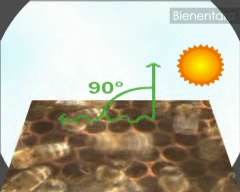
"When
I started Bienentanz, I wanted to create a video that showed what the
company's name was about. One challenge was to make the phenomenon easy
to grasp, in particular how the angle in the upright hive is carried
over into the plain field environment. The
other was to keep the video short, leaving out everything that isn't
absolutely necessary, to appeal to a wider audience. I think the balance
between the video's scientific depth and its ability to keep viewers
on board is just about right."
Christian
Böcker, Managing Director
Bienentanz Gesellschaft für Kommunikation mbH